Posted in Graduating Class

Class of 1915

Class of 1915


 The following 84 Central seniors received diplomas from D H Bloom, President of the High School Board, Hamilton County, Tennessee on June 4, 1915 at the city auditorium. 

Viola Adams  

Harriet Aiken  

Ruby Allen     

Aline Anderson 

Maude Alverson  

Louise Barringer 

Otis Beck      

Bernard Bender   

Clementine Brown  

Herschell Broyles  

Marshall E Broyles  

Preston Bryant   

Read Card  

Mildred Carr   

Donald Chaddick  

George Mercer Clementson  

Lurline Cole  

Susie Combs     

Jesse Payne Conner  

Emmett Cook

Doris Mary Cuneo  

Ruth Vernon Daniel  

Willetta Denton  

Robert F Dickson    

Edith Alma Ealy  

Inez Estell   

William Dean Farris  

Maurice Joseph Fenton 

Dorothy Fitzgerald   

Inez Gray 

Jesse Gross  

Metta Guthrie  

Jesse Hargraves 

Sylvester Harris   

Luther Lee Hartman  

Otto Heard  

Myrtle Hengstler    

Gertrude Lufkin Henshaw    Salutatorian

Henry Hobday 

Mary Lou Hudson  

Wiley Hudson   

R. Swan Hunter  

Richard Johnson  

Bernice Jones 

Rubye Julian   

Willie Melva Lauderbach 

Lillian Grace Lewis 

Clyde H Mansfield    Valedictorian

Otto J Mattil   

Buist McAlister   

Elnora Stella McDonald 

Jane McElhaney 

Alfred McIsaac  

William Hobert Merriam  

Lucy Rae Milburn   

Sam A Morris     

Paul Leo Murphy      

James Newman  

Clair O’Brien  

Joyce Osborne   

Lee Parks 

Adeline Pickering 

Maude Price  

Alice May Prince  

Carleton Randall  

George Revington 

Mary Richards  

Arlington Cornelius Robinson  

Margaret Anne Seagle   

Edna Mae Smith 

Irvin Clarence Smith  

Lenore Stark   

Leafie Street   

Jessie Taylor  

Carrie Tinker   

Linwood Wade   

Avis Warrenfels 

Earnest Patrick West         

Nathaniel Winfield Westbrook   

Mildred Wilbanks   

Huger N Willard  

Doyal P Wilson   

Leroy Clark Wilson  

Amos Woodhead  

Posted in Early History

Early History of Central by Charlie Sedman

The following are articles by Charlie Sedman are extracted from The Central Connection:

On Friday September 6, 1907, Central High School opened for registration at the old Ridgedale School on the corner of Peachtree St. and Bennett Ave.   Central thus became the first high school in Hamilton County to offer a four-year curriculum (City didn’t adopt a four-year program until 1912) and the second county high school (Tyner opened the following Monday).   By September 19, registered students totaled 156, and this number would grow to 230 by mid-year, and then to 306 by the end of the year, aided by the promotion of 76 area eighth graders to the ninth grade at mid-term, as the new building opened.   [Central would not move into the new building, designed to accommodate 500 students, until January 6, 1908.]

The new Hamilton County Plan (1906) was to have one four-year high school offering a full college prep diploma with peripheral high schools offering three-year certificates, requiring all students seeking a diploma to complete their fourth year at the new central high school, thus the name Central High School.  Of course this was very difficult for students living in the Soddy and Sale Creek areas, so in short order their schools, along with Hixson and Tyner, were expanded to a full four-year program.  But the original central school retained the name Central High School.  So now you know.

The majority of Central students in the early days were mostly nearby, i.e, within walking distance or a streetcar ride from school, meaning that students from areas north of the river or well east of the ridge had some logistical problems getting to Central.   Teachers and students mostly lived in the Glenwood-Ridgedale-Highland Park-Eastside-East Chattanooga area. A very few of the notable early grads like Creed Bates (1911) commuted all the way from St Elmo. Very little indication that the farm kids came into town to go to school. Also Soddy, Tyner, Sale Creek, and Hixson then were very small schools by comparison to Central and City; graduating classes in the 1910-20 era were single digits compared to Central and City being near 100 each. In the 1920s more students from Eastdale-Brainerd-East Ridge and Hill City (North Chattanooga) flowed in as those areas transitioned from rural to suburbs.   The Hoodenpyl (Signal Mtn) and Olinger (moved from Soddy to Riverview) clans are examples of large rural famililes sending their kids to Central in the 20s as transportation improved. This necessitated the big expansions of the building in 1923 (auditorium and south wing) and 1927 (Science or north wing), and again in 1937 (west extensions off the north and south wings). In summary, early Central students were mostly urban kids and did not have to choose between school and farm chores. This is also the reason the rural high schools did not field competitive athletic teams for decades – fewer students and limited time for after school activities, e.g. gym was athletic team practice.

Posted in Central Athletics, Early History, Football

Central’s First Football Team by Charlie Sedman

On Tuesday, September 10, 1907, the Chattanooga Times reported on page 3, “The Central high school is now figuring on a football team.  Among the members of the county high school faculty is Coach (Curtis) Green, formerly of the Battle Ground Academy, Franklin, Tenn….it is believed he will put out a fast team at Central high school, providing money can be secured to start the movement.”

This answers the question, “Which came first, Central or the football team? And the answer is the school, but only by a few days.  The football team did precede classes in the new building by nearly three months.

I’ll have a few followup notes under the 101 Years ago heading, leading to Central’s first two football games in October 1907 against Baylor and City.

Posted in Authors' Chatter, Preservation of History, Stories by Central Veterans, Thanks

Notice to All Veterans Who Attended Central

One of our goals is to capture the stories of all who attended Central and served on active duty, or in the Reserves, or National Guard.

Central attendees and graduates endured WWI, WWII, Korean Conflict, Viet Nam Conflict, Cold War, and Middle Eastern Conflicts (and others not so well known).

Central brothers and sisters who served in law enforcement and fire protection, we intend to capture your stories too.

So…..share your stories.

Posted in Faculty

New Faculty 1912-13

New Faculty 1912-13


Principal A E Darrah was relieved at the end of the 1911-12 school year and was replaced by City High Principal John S Ziegler.  Other faculty members leaving with Darrah included music instructors Charles and Julia Garratt (replaced by Reita Faxon Pryor), Harriet Greve (took leave for MA at Columbia), and Mary Elizabeth Beck. Alpha Davis was added as a science teacher and Marguerite Aull for English and Speech.

Marguerite Aull  was born in Cincinnati, OH to German immigrant Edward A Aull and Mary Schroeder Aull in 1885. Her family moved to Chattanooga around 1890 where her father was a prominent businessman and member of the Board of Education.  Marguerite and her  younger sister Katrina both attended and received BA degrees from UC.  In the 1909-10 UC register, Marguerite was listed as the first librarian on record.  She was teaching at the 20th District school in St. Elmo before joining  the Central High faculty in 1912 as a Speech and English teacher.  Aull remained on the faculty until the end of the 1920-21 school year, when she took leave to complete her MA at the University of Wisconsin. She returned to teaching at City High in the fall of 1923. She was a member of the National Speech Arts Association and a pioneer in teaching gifted students. Her article, “Capitalizing the Extra Bright Child ” was featured in the Peabody Journal Of Education Vol 2, No.3, Nov.  1924. Aull was also considered an expert librarian, having organized libraries in Cleveland and Richard City, TN and at Ursuline College. She was also heavily involved with the Chattanooga Little Theater from its inception.  Unmarried, she passed away at only 44 years of age on Feb 27, 1929 at Erlanger Hospital and was buried in Cincinnati.

Alpha Davis, the oldest of three children, was born  in Morganville, Dade County, GA Sept 11, 1887 to Dr. Kansas D and Lula Rogers Davis. Her family moved to St. Elmo before 1900 and she graduated from UC  around 1910. Ms. Davis taught at the Third District school before joining Central’s faculty in 1912 as a science teacher. Davis left Central at the end of the 1916-17 school year, married lawyer (later judge) George E Westerberg on 9/12/17, and moved to Cleveland, TN. She remained active in Chattanooga, serving as a regent for the Chattanooga Chapter of DAR and president of the local UDC.  Alpha and George had two children,  George D (1919) and Ellen (1923). Alpha taught English and history at Bradley County High until the early 1940s. In 1937 she directed a local history project wherein her students collected and submitted family histories to the Bradley County library. Her daughter also archived local history records for Bradley County before WW2. Alpha Davis Westerberg  passed away on Feb 12, 1965 and is buried in Fort Hill Cemetery, Cleveland TN beside her husband and two children.

Reita Faxon Pryor was born in Clarksville, TN  August 1, 1876, the third of four children,  to John Wellington and Florence Herring Faxon.  Her father  served in the Confederate Army, became a prominent banker in Clarksville, and moved to Chattanooga in 1891 to become Assistant Cashier of the  First National Bank.   Ms. Faxon studied voice in Germany  and married William Henry Pryor Oct 5, 1909 in New York City. W H Pryor became an insurance executive with the Pryor, Love, and Lewis firm in Chattanooga.

Ms. Pryor was heavily involved in the local chorale and symphonies, performing in public many times as a soprano and served on the Community Concerts Board. She accepted an appointment at Central in fall of 1912 to teach vocal music and direct the glee clubs, and remained at Central until 1921. She and her husband were childless and moved to Summertown on Signal Mountain in the 1920s where they lived for many years.  Widowed, Ms Pryor moved to Lookout Mountain in 1957, passing away on her 82nd birthday, August 1, 1958.

Central’s second principal, John Sherman Ziegler,  was born in Meigs County, TN on Feb 3, 1873, the third of eight  children to William B. and Tennessee Reynolds  Ziegler.  After education in the Meigs schools, Ziegler taught for several years before entering  UT  IN 1895, being admitted to Law School in 1897, and graduating with an LLB in 1899. Ziegler returned to teaching, coming to the Chattanooga school system in the early 1900s, culminating in his appointment as the Principal of City High in fall, 1910. He was publicly opposed to playing Central in athletics while Darrah was principal, and, ironically, became Darrah’s immediate successor in the fall of 1912. Ziegler was noted for ousting  former  Darrah allies and drew public criticism for his dismissal of Charles McGuffey in 1915. Under Ziegler, faculty turnover increased markedly over his predecessor.  His lack of support for Coach Rike was a major factor in Central’s rapid decline in athletics and Rike’s resignation in 1918. Ziegler was, however, responsible for one major part of Central’s traditions, in that he requested funds  (that were approved) and initiated  military training in the spring of 1916, leading to Central’s being the first JROTC unit in Tennessee in 1919. Ziegler left Central at the end of the 1920-21 school year (replaced by Stacy E Nelson), eventually becoming the Supt of Hamilton County Schools, then State Superintendent of Schools,  and finally the first president of Austin Peay College in Clarksville , TN in 1929.  At the end of his first year at Austin Peay,  Ziegler became ill while giving an address to the graduates of Clarksville High School, and succumbed to an apparent heart attack on May 8, 1930. He was buried two days later in Forest Hills Cemetery in Chattanooga. He and his wife, Margaret, had no children.
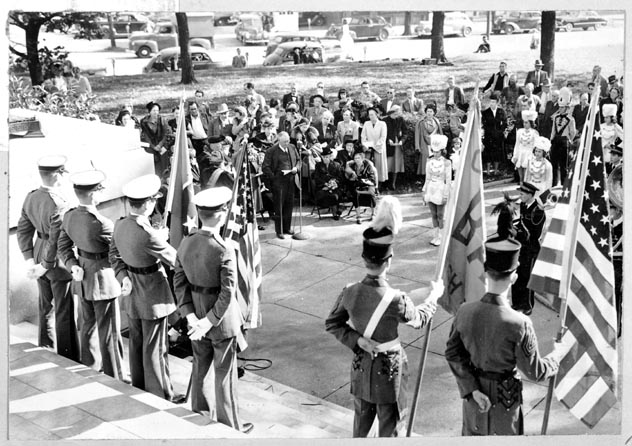
Posted in Central Veterans, Gary Thomas

Gary Thomas, Sr., Class of 1953

I am married to Patricia Genter Thomas (Central High 1956) and we have a son & 2 daughters, 5 g-children & 4 gg-child. My wife & I were married on August 30,1957. Before going to college I was in the Army for 3 years…..then Combustion Engineering for 5 years…..then to University of Chattanooga for 2 years, then to Samford University, Birmingham, AL, for 3 years graduating with a degree in Pharmacy. Then to Rhyne Pharmacy, Rossville, Ga -then to Cole Drug bought by Revco Drug bought by CVS Pharmacy…..Campbell Clinic Pharmacy bought by Medical Park Hospital…..Memorial Hospital Pharmacy…..Parkwood Nursing Pharmacy…..Valley Psychiatric Hospital….K-Mart Pharmacy…..Georgia State Board of Pharmacy, Atlanta, Ga…..All jobs were in Chattanooga, TN, except for Rhyne Pharmacy in Rossville, Ga and Georgia State Board of Pharmacy in Atlanta, GA. In Febuary of 2003 I retired from CVS Pharmacy after working as a pharmacist for 40 years. I was in the Army from Feb 1954 till 2-27-57. Basic training at Ft Jackson, SC., advanced infantry training and Metorologist School at Ft Gordon, GA., and Airborne school at Ft Benning, Ga., all of the former was with the 101st Airborne Division then to Ft Lewis, Wash., then to Japan, where I was assigned to the 1st Cavalry Division Artillery HQ HQ as a Metorologist (Some of our unit was stationed in Inchon, Korea and I was TWY to Inchon on two different occasions) -Camp Chitose, Hokkaido, to Camp Youngins, Honshu, to Camp Sindi, Honshu, to Camp Drake, Honshu. I was in Japan for 2 years except for two TDY tours to Inchon, Korea & a TDY to Okinawa. While in Japan I took 30 days vacation. Although I visited Kobe, Nagoya, Osake, Okinawa & Hiroshima in the south. My favorite place was in the north, which I visited twice, was Kegon Falls near the city of Nikko at the base of Mt Nantai and Lake Chuzhen. The city of Nikko was removed from the bombing maps of the US Air Force during WWII due to the many religious temples. Nikko & Kegon Falls is about 75 miles north of Tokyo and has many temples, shrines and a sacred bridge. A very beautiful area of Japan. In Feb of 1957 I returned to Ft Lawton, Wash and then to Ft Smith, AK., & then HOME to Chattanooga.

Posted in Early History, Faculty

Remember, “We are from Central”

This quote printed at the bottom of page 9 of The Central Digest, October, 1910, caught my attention.  Below is an extract from the article entitled “What Central Means” on that same page.

The launching of the enterprise of the County High School in Hamilton County was attended by a rare conjunction of favoring conditions: fearless, intelligent, broad-minded men in places of power endorsed by an equally intelligent and broad-minded public; so Central, in addition to an auspicious launching, with two progressive men in the respective chairs of principal and superintendent, may verily be said to sail under a lucky star. Her future may be judged by her past; and the most conservative mind must predict for her a growth and development that will rank her the equal at least, of the foremost high school in the state. N. C. C.

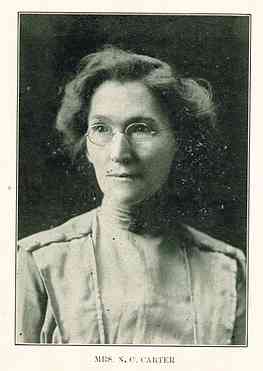
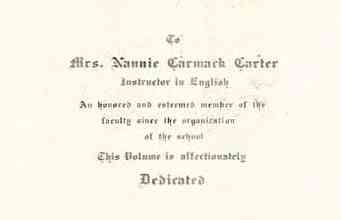
Charlie Sedman provided Nannie Carmack Carter as the name represented by the initials:

English teacher when Central opened its doors to students in the fall of 1907.
The Central 1913 Dedicated to Nannie Carmack Carter
Posted in Chattanooga History

Market Street Bridge

By 1911, load limits and costly repairs of the Walnut Street Bridge led officials to begin planning for a new bridge.  Many officials and residents of Chattanooga wanted a Market Street Bridge because so much of the traffic crossing the river was destined for Market Street, the commercial center of downtown.  But officials also wanted a concrete bridge because maintenance would be easier. Construction began in 1914, and the Bridge opened in 1917.