Posted in Early History, Library

Central Library

This CENTRAL HIGH HISTORY moment was copied from Central Alumni NewsLetter authored by Susan Watkins Kendall Class of 1978 (see Central News).

There’s no better time to research, show off, and preserve Central’s history than during our Centennial year!   I thought everyone might enjoy this bit of history about Central’s E. Y. Chapin Library.  Ed Hoback

HISTORY OF THE E. Y. CHAPIN LIBRARY written in 1970 by Mrs. Pansy Allison, Central High Librarian

When Central High School was organized, a library was not included in the original plans.   In the early 1920s, Mr. John Setliffe, a Latin teacher, felt the need for an organized collection of books.   He gathered together a number of books which were located in an area under the south stairs on the first floor.   In 1926, Central was given some donations from a private classical library, and in cooperation with the Chattanooga Public Library, the Hamilton County Board of Education was able to organize a library for Central.   The library was then located behind the rotunda, directly over the cafeteria.

During the years of the Depression, Central’s book supply was running low.   Just when it seemed Central would have to give up the library, the Hamilton County Board of Education, in order to meet standards set by the Southern Association of Libraries, appropriated $2,000 to buy enough books to maintain the library.   After the Depression, Central built the left wing of the school, and in 1937 the library moved to that location.   Until 1952, Central maintained three librarians, but when student enrollment dropped below 2,000, two librarians were enough to run the library.

In 1938, the library was added to the school as a branch of the Chattanooga Public Library and was named in honor of Mr. E. Y. Chapin.   Several years later, Central’s library broke away from the Public Library and since that time has been supported by the Hamilton County Board of Education.   In 1950, Mr. E. Y. Chapin donated $3,000 to buy books.   In his will, he left the school an endowment fund which has gone a long way toward making Central’s library the largest high school library in the South.

Since 1927, the head librarians of Central High have included:

  • 1927-29:  Garnett Leader
  • 1928-29:  Mary W. Atkinson
  • 1929-30:  Elizabeth Lacey
  • 1930-43:  Augusta Kolwyck
  • 1943-61:  Mary Sanders
  • 1961-69:  Ellen Mullennix
  • 1969-70:  Ariel Colburn
  • 1970-86:  Pansy Allison

In 1969, the Central High School Library moved into its new location at the school on Highway 58 in Harrison.

Posted in Central Seal

Central Seal

I was the President of the Class of ’61 (Charles Smith) and our senior class gift to the school was the school seal.   Attached should be a newspaper photo of me presenting the seal to W. Holbart Millsaps.   I have the original sketch shown in   the photo along with the 2 other designs that were considered before we agreed on the final design – they are approx. 14″ by 14.”   I also have the first embossed seal on paper from the hand seal that we had fabricated to use on stationery, official papers, etc.

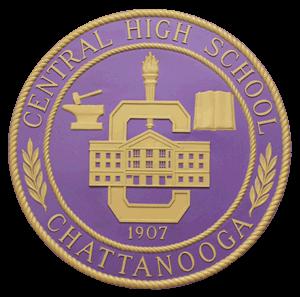
Some background:  In the spring of 1961, the class officers had a meeting with Mr. Millsaps to discuss a class gift.   He suggested that we could “present an official seal” which was needed on school communications.   I thought that would be very easy since we were all busy with the end of school activities.   All that we would need to do is get a copy of the seal and have a hand stamp fabricated.   However, Mr. Millsaps informed us that the school did not have a seal, and we would have to design one.   This initiated several months of activities to design the seal which is now used on most communications from Central.   It includes the front of the building on Dodds Ave., “open book” representing knowledge, “torch” representing leadership, and “anvil” representing school spirit.

Posted in Central Athletics, Early History, Football

More of Charlie Sedman’s Posts to The Central Connection

September 9, 2008:

On Tuesday, September 10, 1907, the Chattanooga Times reported on page 3, “The Central high school is now figuring on a football team.   Among the members of the county high school faculty is Coach (Curtis) Green, formerly of the Battle Ground Academy, Franklin, Tenn….it is believed he will put out a fast team at Central high school, providing money can be secured to start the movement..”

This answers the question, “Which came first, Central or the football team? And the answer is the school, but only by a few days.   The football team did precede classes in the new building by nearly three months. I’ll have a few followup notes under the 101 Years ago heading, leading to Central’s first two football games in October 1907 against Baylor and City.

September 12, 2008:

Central’s football teams have faced many great players and coaches over the years.   One such encounter occurred in the Fall of 1919. New head coach Rusty Cornelius had to cope with losses of star players who were “recruited” along with Coach Rike to Baylor, and an inexperienced team that had played only three games the previous year with no head coach. Cornelius hastily cobbled together a schedule of seven games with whoever was available. Remarkably, with great leadership from a junior quarterback named Dean Petersen, Cornelius forged a 5-1-1 record, with five shutout wins, the only blemishes being a 0-0 tie with Rike’s all-star Baylor team and a decisive 33-6 thumping by an obscure military school, Fitzgerald-Clarke Academy of Tullahoma, Tennessee. The 33 points by Fitzgerald-Clarke were the only points allowed by Central that season.

So what was Fitzgerald-Clarke Military Academy? Turns out it was one of a handful of college prep schools used by Vanderbilt and other colleges to help promising athletes pass college entrance exams. In this particular year, 1919, Fitzgerald-Clarke had, amongst others, a 6-1, 210 lb lineman named Lynn Bomar from Texas, who would later become an All-American at Vanderbilt and play professional football for the New York Giants. Ironically, 1919-20 was Fitzgerald-Clarke’s last year as an institution, for the school barracks burned down just after the football season ended, then the school burned down and never reopened.   But perhaps more noteworthy was their young football coach who, out of a job after the school calamities, followed the pipeline to Vanderbilt as an assistant coach. By 1923, at age 31, he was head coach at Alabama, then by 1930 head coach at Duke, where he would remain until 1950. Overall he won three National Championships at Alabama in seven years and had an unprecedented winning   (110-36-7) record at Duke. Plus a 1-0 career record against Central. His name   –   William Wallace Wade.

Posted in Early History, Historical Background

More of Charlie Sedman’s Posts to The Central Connection

September 5, 2008:

On Friday September 6, 1907, Central High School opened for registration at the old Ridgedale School on the corner of Peachtree St. and Bennett Ave.   Central thus became the first high school in Hamilton County to offer a four-year curriculum (City didn’t adopt a four-year program until 1912) and the first county high school (Tyner opened the following Monday).   By September 19,   registered students totaled 156, and this number would grow to 230 by mid-year, and then to 306 by the end of the year, aided by the promotion of 76 area eighth graders to the ninth grade at mid-term, as the new building opened.   [Central would not move into the new building, designed to accommodate 500 students, until January 6, 1908.]

September 7, 2008:

The new Hamilton County Plan (1906) was to have one four-year high school offering a full college prep diploma with peripheral high schools offering three-year certificates, requiring all students seeking a diploma to complete their fourth year at the new central high school, thus the name Central High School. Of course this was very difficult for students living in the Soddy and Sale Creek areas, so in short order their schools, along with Hixson and Tyner, were expanded to a full four-year program. But the original central school retained the name Central High School. So now you know.

September 8, 2008:

The majority of Central students in the early days were mostly nearby, i.e, within walking distance or a streetcar ride from school, meaning that students from areas north of the river or well east of the ridge had some logistical problems getting to Central.   Teachers and students mostly lived in the Glenwood-Ridgedale-Highland Park-Eastside-East Chattanooga area. A very few of the notable early grads like Creed Bates (1911) commuted all the way from St Elmo. Very little indication that the farm kids came into town to go to school. Also Soddy, Tyner, Sale Creek, and Hixson then were very small schools by comparison to Central and City; graduating classes in the 1910-20 era were single digits compared to Central and City being near 100 each. In the 1920s more students from Eastdale-Brainerd-East Ridge and Hill City (North Chattanooga) flowed in as those areas transitioned from rural to suburbs.

The Hoodenpyl (Signal Mtn) and Olinger (moved from Soddy to Riverview) clans are examples of large rural famililes sending their kids to Central in the 20s as transportation improved. This necessitated the big expansions of the building in 1923 (auditorium and south wing) and 1927 (Science or north wing), and again in 1937 (west extensions off the north and south wings). In summary, early Central students were mostly urban kids and did not have to choose between school and farm chores. This is also the reason the rural high schools did not field competitive athletic teams for decades – fewer students and limited time for after school activities, e.g. gym was athletic team practice. Think of it Ed, NO two-a-day practices in August.

Posted in Football, Purple Pounders

Ledford’s Biggest Hit; a Football Story Almost Forgotten

The following posted on The Central Connection November 11, 2008

On October 15, 1937 Central made a return trip to Cleveland where two years before they had so decisively dominated the Bradley County football team, that Chattanooga Times reporter Springer Gibson anointed them the “Purple Pounders” for the first time.   On this evening, Central again ruled the first half in front of a disgruntled group of Bradley fans.   During the opening kickoff of the second half, the Pounder’s football Captain, Dexter Hodges, was running free on an apparent 80-yard touchdown return, when he was rudely upended by a shoestring tackle via one Charles Ledford on the 10 yard line.   On the next play Central would fumble near the goal line, and Bradley would temporarily hold, eventually losing 21-0; so Ledford’s solid hit would not change the outcome of the game, other than shaving 6 or 7 points off Central’s winning margin. Hodges would later remark that Ledford’s tackle was the hardest hit of the game against Central.

There would not be a story here, except that the 5 ft 8 inch, 130 pound tackler was a 21 year old taxi driver, who, taking the dare of some buddies at halftime, resolved to tackle the next Central runner approaching Bradley’s goal. And the opening kickoff breakdown by Bradley’s coverage team gave him ample opportunity to show his talent.   As Hodges looked back to see if any Bradley player were in close pursuit (they weren’t), he didn’t see the fan come out of the stands and lunge headfirst at his ankles, ending his race down the sidelines.   The referees didn’t know exactly how to rule, and curiously decided (as home refs are wont to do) to penalize Bradley half the distance to the goal, rather than award the visitors a touchdown that was the certain outcome, had Ledford not inserted himself into the fray.

The Chattanooga Times gave this play the game highlight, as it was the most newsworthy action that occurred that evening in Cleveland.   Some 16+ years hence at the Cotton Bowl, an Alabama player named Tommy Lewis came off the bench to tackle Rice star Dickie Moegle , abruptly ending what would have been a 95 yard touchdown from scrimmage.   In that venue, the referees rightly awarded Rice a touchdown in a 28-6 win over ‘Bama.   The following day, Wirt Gammon of the Times favorably compared the 1937 Bradley-Central and 1954 Cotton Bowl fiascoes in his “Just Between Us Fans” column.   Upon reading Gammon’s essay, Mr. Ledford, still a resident of Cleveland, made a hasty phone call to Gammon, in which he protested the comparison, asserting that (1) he was a civilian in street clothes while Lewis was a highly skilled athlete in full pads, and (2) Lewis did not prevent the opposing team from scoring, while his own effort had indeed prevented Central from scoring.

Most of the above information was recently e-mailed to me by Charles Ledford, Jr. of Hiram, GA, who had read my Central Football history essays at the Chattanoogan.com and wanted to know if I had any details of the incident (I didn’t, other than that an unnamed Bradley fan had indeed tackled Mr. Hodge to start the second half). This was apparently a favorite family story of the Ledford’s for many years. Charles E. Ledford Sr. went on to serve in the Army during WWII, and was on Iwo Jima when the famous flag-raising occurred on Mt. Suribachi February 23, 1945. Ledford returned to Cleveland after the war and raised a family, serving as a firefighter.   His youngest son played for Bradley County against Central in 1967 in a game won by Central in Cleveland 26-7, but was marred by the collapse and eventual death of Central’s star end Mike Perkins.

[Just another hidden story in the annals of Central football; thought some of you would enjoy it.]

Posted in Historical Background

Hamilton County History

Charlie Sedman’s post to The Central Connection on February 28, 2009:

Hamilton County was formed Oct 25, 1819 as a result of the Calhoun Treaty giving all Cherokee land North of the Tennessee River and Hiwassee River to Tennessee.   First county seat was at Dallas. Joseph Vann, a wealthy Cherokee, owned a large plantation at the mouth of Ooltewah (Wolftever) Creek across the Tennessee River from Dallas, and operated a ferry to Dallas. In 1828 Georgia confiscated all Cherokee lands, driving Vann from his largest plantation in Georgia to refuge in Tennessee.   Vann lived at his Tennessee plantation (which in 1828 had 110 slaves, 35 houses, a mill, three horse racing courses, and a ferry boat) until 1838, when all Cherokees were removed forcibly.   The New Echota treaty of December 1835 gave all Cherokee lands to Tennessee, so Hamilton County was extended to the Georgia border. A land office was set up in Cleveland in November 1838 to sell the parcels south of the Tennessee River, including the Vann plantation.

A group of prominent citizens was charged by Hamilton County to consider relocation of the government and that group chose the new community of Harrison near the old Vann plantation, to be the new county seat in January, 1840. Coincidentally, that same group of prominent citizens had previously purchased all of Vann’s estate and much more, had surveyed and laid out a new town, and had named the new location Vanville, and were offering lots for sale in 1839.

The name was changed to Harrison (named for the new US President) in 1840 when the county government was moved across the river.   Harrison began competing almost immediately for the new railroad planned from Marthasville (now Atlanta) Georgia to the Tennessee River, but lost out when the State of Georgia was offered a large piece of land by Chattanooga (later housing the old Union Station on Broad Street).

So Chattanooga became the railroad center and Harrison remained a small community. In 1870, the County seat moved to Chattanooga, and, in protest, Harrison residents successfully petitioned the courts to form a new County, James, with intentions of becoming the new county seat. However, in an 1871 referendum, Ooltewah was voted the James county seat. So Harrison remained a small community until flooded by Chickamauga Lake in 1940.   As a footnote, one of the earliest Hamilton County residents south of the Tennessee River was Thomas Guthrie, who on August 7, 1839, secured a land grant of 160 acres one mile north of Vanville (Harrison) on Georgetown Road, where he lived and raised 8 children.

Posted in Military Training and JROTC

Rich History of JROTC at Central

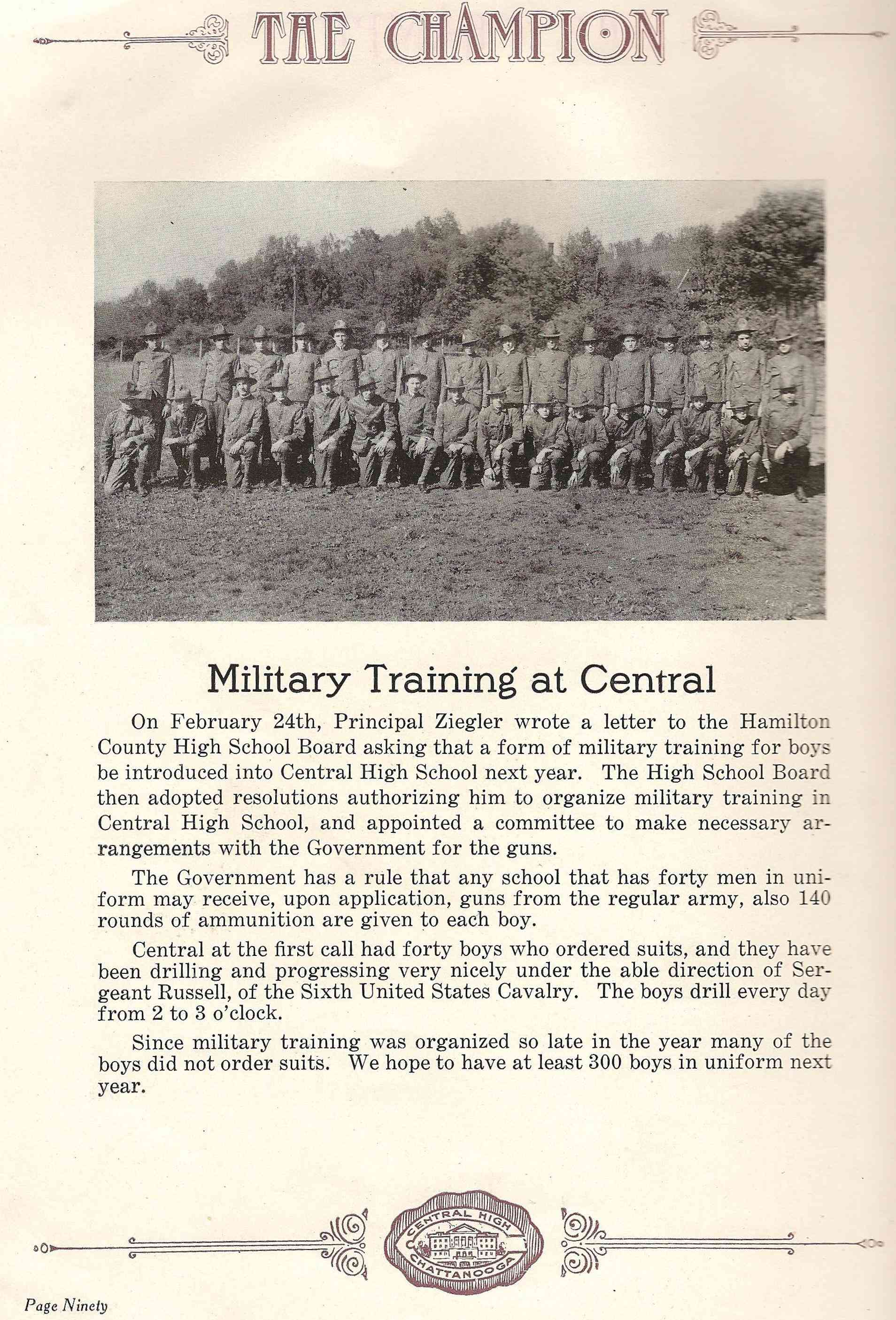
In anticipation of World War I, Central’s Principal Ziegler and faculty requested a military training program in 1916.  The program was approved by the Hamilton County School Board, preceding JROTC at Central.  On December 29, 1919, the first Junior Reserve Officer Training Corps (JROTC) unit in Tennessee activated at Central.  The Principal’s vision, preparedness for junior military training, and the fine reputation Central held in the State undoubtably were factors in Central’s choice as one of the first 30 pilot JROTC units created by Congress and the War Department in 1916 for the United States.

In 1927, the United States Army instituted Honor Unit (later renamed Honor Unit with Distinction) awards.  The Central Unit has been an Honor Unit with Distinction since 1927.  Further, it has been continuously in operation since 1919, making it the longest continuously operating unit in the South.

An average of 185 cadets graduate annually, approximately 16,000 since 1919.  Many have gone on to serve as commissioned and noncommissioned officers in one of our Country’s military services.  If you are one of them, please share that with us by clicking on comment and telling us about your military service.  If you know of Centralites who died in combat, please help us identify and honor them.

Posted in Historical Marker on Dodds Avenue

Monument & Markers Committee Changes Central Historical Marker Text

On January 31, 2012, the Monument & Markers Committee of the Tennessee Historical Commission considered our application, modified our proposed text, and recommended approval of our marker.

Modifed text:    “From 1908 to 1969, this was the site of the first Hamilton County high school to offer a full four year curriculum.  From an initial graduating class of 19, the school grew to an enrollment of approximately 2000 students, making it one of the largest high schools in the state for a significant period.  In 1919, the first Junior Reserve Officer Training Corps unit in Tennessee was organized here.  In 1963, Central proudly accepted the 22nd annual National Bellamy Award, one of the nation’s highest merit honors for secondary schools.”

On February 17, 2012, the full Commission will vote on our application.